Sponsored article
What Quality and Documentation Requirements Determine Whether Recycled Plastic Can Be Used in Industry?
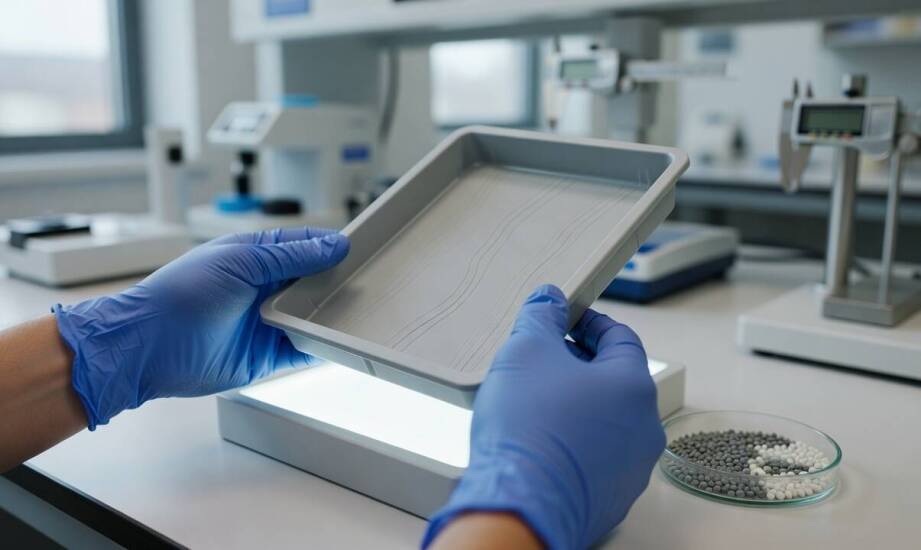
- How Should Recycled Materials Be Evaluated for Technical Components?
- What Requirements Apply to Recycled Plastics for Food Contact?
- What Matters for Promotional and Display Products?
- Why Is Traceability Important?
- How Is Recycled Plastic Used in the Automotive Industry?
- What About Recycled Plastics in Construction?
- Can Recycled Plastics Be Used in Medical and Laboratory Products?
- Why Does Material Qualification Matter in Series Production?
- How Does Noex Approach Recycled Plastic Products?
- When Is Recycled Plastic the Right Choice?
- FAQ
- Is recycled plastic worse than virgin plastic?
- Why is MFI or MFR important in injection moulding?
- Can recycled plastic be used in food packaging?
- Which industries use recycled plastics?
- What does material traceability mean?
- Does recycled plastic always reduce a product's carbon footprint?
- How can quality risks be reduced when introducing recycled material?
In B2B projects, simply stating that a product contains recycled plastic is rarely enough to support a purchasing or engineering decision.
Read more: How does a metal deburring machine work?
Industrial customers need to know whether the material can provide consistent performance, whether its origin is traceable and whether the required technical documentation is available.
This is particularly important when recycled material is introduced into series production. A change of raw material may affect processing behaviour, dimensions, appearance or mechanical properties, so the recycled grade should be evaluated against the requirements of the specific application.
Clear quality criteria and reliable documentation therefore play a central role in reducing production and supply-chain risks.
How Should Recycled Materials Be Evaluated for Technical Components?
For technical parts such as housings, structural components or machine elements, the key question is not whether recycled material performs identically to virgin polymer.
It needs to meet the performance requirements established for the finished component.
Depending on the application, relevant parameters may include:
tensile and flexural properties;
impact resistance;
dimensional stability;
fatigue performance;
melt flow rate;
operating temperature;
chemical resistance;
UV resistance.
MFR or MFI can be useful indicators when evaluating processing consistency.
Significant differences between batches may require changes to injection moulding parameters and can influence filling behaviour or part dimensions.
However, MFI alone is not sufficient to determine the quality of a recycled polymer.
Material composition, contamination, previous processing history and mechanical properties may also influence the final result.
For this reason, industrial buyers should define acceptable parameter ranges rather than rely only on the general designation of a recycled material.
What Requirements Apply to Recycled Plastics for Food Contact?
Food-contact applications require a different level of regulatory control.
In the European Union, recycled plastic materials and articles intended to come into contact with food are subject to Regulation (EU) 2022/1616.
The regulation covers requirements for recycling technologies, processes and installations as well as the use of recycled plastic in food-contact materials.
For relevant recycling processes, safety assessment may involve EFSA.
The purpose of this evaluation is not merely to test one finished material sample. It also considers whether the recycling process can sufficiently control contamination and produce material suitable for its intended food-contact application.
This means that recycled material from an uncontrolled source cannot automatically be used for food-contact packaging simply because its polymer type appears suitable.
Documentation of the recycling process, material origin and compliance status therefore becomes essential.
What Matters for Promotional and Display Products?
Products used in advertising, point-of-sale applications or visual displays can have a different set of quality priorities.
Mechanical requirements may be less demanding than in highly loaded engineering components, while appearance becomes more important.
Relevant acceptance criteria may include:
colour consistency;
surface quality;
gloss;
visible inclusions;
flow marks;
scratches;
print compatibility.
Recycled polymers can sometimes show greater visual variation depending on the quality and origin of the feedstock.
This does not mean that recycled material must look inferior.
Controlled industrial grades can provide good visual consistency, provided that realistic acceptance criteria are established before series production begins.
For branded products, it is particularly important to agree on colour tolerances and reference samples in advance.
Why Is Traceability Important?
Traceability makes it possible to verify where recycled material comes from and how it moves through the supply chain.
Depending on the certification system, this may include information about:
the source of the recycled feedstock;
the recycling process;
the recycled-content percentage;
the converter using the material;
documentation supporting product claims.
RecyClass offers a Recycled Plastics Traceability Certification designed to track recycled plastic throughout the value chain and verify recycled-content claims.
Its system is linked to recycling-process certification based on principles aligned with EN 15343.
This type of documentation is increasingly important for companies that need to substantiate claims such as a defined percentage of recycled plastic in a finished product.
How Is Recycled Plastic Used in the Automotive Industry?
The automotive industry places particularly high demands on material qualification and supply-chain documentation.
However, the technical requirements vary substantially depending on where a component is used.
An exterior part exposed to sunlight and road conditions may require strong UV and chemical resistance, while an interior component may be evaluated according to different criteria.
Flammability requirements are also relevant for specific vehicle applications, particularly interior materials, but they should not be presented as identical for every plastic component.
The regulatory importance of recycled plastics in vehicles is also increasing.
Under the EU's new rules for a more circular automotive sector, recycled-plastic content in new vehicles is set at a minimum of 15% from 2032, increasing to 25% from 2036.
For manufacturers and suppliers, this strengthens the importance of traceable material sources and validated recycled grades.
What About Recycled Plastics in Construction?
Construction products are often expected to remain functional for many years under changing environmental conditions.
Depending on the product, requirements can include:
mechanical stability;
weather resistance;
UV exposure;
freeze-thaw resistance;
dimensional stability;
long-term ageing behaviour.
The exact tests depend on the intended application and the relevant product standard.
A recycled polymer used in a pipe, insulation component or profile therefore cannot be assessed using one universal set of requirements.
For regulated construction products, manufacturers may also need to provide declarations and performance documentation required by the applicable legal and technical framework.
Environmental documentation is becoming increasingly important as well, particularly in projects where lifecycle impacts are evaluated.
However, the use of recycled content alone does not automatically prove a specific reduction in carbon footprint.
Such claims should be supported by appropriate lifecycle or environmental data.
Can Recycled Plastics Be Used in Medical and Laboratory Products?
They can, but these sectors require particularly careful qualification.
Medical and laboratory products vary greatly in terms of risk.
Some applications require strict control of:
chemical purity;
extractables and leachables;
microbiological contamination;
biocompatibility;
sterilisation resistance.
Other products may have significantly lower requirements.
Clean-room manufacturing is therefore not automatically required for every medical or laboratory plastic component.
It depends on the intended use, regulatory classification and contamination risk associated with the specific product.
Similarly, recycled material should not be excluded automatically.
Its suitability must be demonstrated for the particular application through appropriate validation and documentation.
For highly sensitive products, however, maintaining the required purity and traceability may make the use of recycled feedstocks considerably more difficult.
Why Does Material Qualification Matter in Series Production?
Introducing recycled material successfully requires cooperation between material suppliers, engineers, quality teams and production specialists.
The material should be qualified against measurable criteria before full-scale production begins.
These may include:
defined polymer type;
recycled-content level;
source and traceability;
MFR range;
mechanical properties;
colour specification;
dimensional requirements;
contamination limits;
relevant compliance documentation.
Trial production is particularly useful when changing from a virgin material to a recycled grade.
It allows engineers to verify whether processing parameters need to be adjusted and whether the finished component remains within the required quality limits.
Material preparation should always follow the requirements of the specific polymer. Moisture control and drying may be critical for some materials but unnecessary for others.
How Does Noex Approach Recycled Plastic Products?
Noex states that its recycled products are made from secondary raw materials obtained from reliable sources and manufactured using process solutions intended to maintain the required product quality.
The company's ECO-LINE includes recycled plastic products such as advertising items, office accessories and everyday products.
For B2B customers, the important point is not simply that recycled material is used.
The material still needs to be appropriate for the intended product, processing method and quality requirements.
This approach makes recycled polymers a practical engineering option rather than merely an environmental marketing claim.
When Is Recycled Plastic the Right Choice?
Recycled material is suitable when its documented properties meet the requirements of the intended application.
The decision should consider:
technical performance;
processing stability;
traceability;
regulatory requirements;
visual expectations;
product safety;
lifecycle requirements.
A high-quality recycled grade does not have to be inherently worse than virgin material.
At the same time, recycled content should not be treated as automatic proof that a product is technically equivalent or environmentally superior.
The strongest industrial applications of recycled plastics are those in which material selection, documentation, testing and process control are considered together.
FAQ
Is recycled plastic worse than virgin plastic?
Not necessarily. High-quality recycled grades from controlled sources can provide stable and repeatable properties. Their suitability should be evaluated against the actual requirements of the finished product.
Why is MFI or MFR important in injection moulding?
MFI or MFR provides information about the flow behaviour of molten thermoplastic under defined test conditions. Significant changes between batches may indicate that injection moulding parameters require adjustment, but melt flow should not be used as the only material-quality criterion.
Can recycled plastic be used in food packaging?
Yes, but recycled plastics intended for food contact must meet the applicable EU food-contact requirements. Depending on the recycling technology and process, specific safety evaluation and authorisation requirements may apply.
Which industries use recycled plastics?
Recycled polymers are widely used in packaging, construction, automotive, furniture, promotional products and many technical applications. Their suitability depends on the requirements of the specific product.
What does material traceability mean?
Traceability means being able to document the origin and movement of recycled material through the relevant stages of the supply chain. It can also support verification of the declared recycled-content percentage.
Does recycled plastic always reduce a product's carbon footprint?
Not automatically. Recycled plastics can reduce demand for virgin raw materials and may offer environmental benefits, but the actual carbon footprint depends on the material, recycling technology, transport, energy mix and complete product lifecycle.
How can quality risks be reduced when introducing recycled material?
Useful measures include supplier qualification, defined material specifications, trial production, incoming-material control, monitoring of critical process parameters and documented acceptance criteria.
You might be interested

What Are the Latest Innovations in Cardboard POS Display Design?

Variety of System Entrance Mats in Floor Protection for Offices

How High Firing Affects the Durability and Care of a Hand-Decorated Ceramic Vase